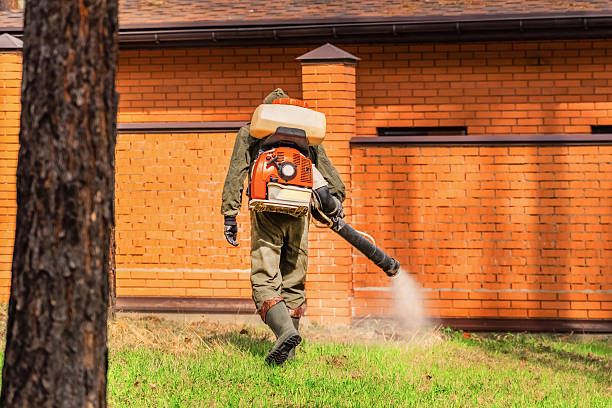
DIY spray aimed at a wasp nest from 10 feet away increases aggression and rarely eliminates the full population. Show Me Pest Control's technicians in St. George arrive with proper protective equipment, locate every nest on the property, and eliminate them in the correct sequence.
The nest you know about and the ones you do not are all treated in the same visit.
Before treating the nest you called about, we sweep the property for all others. Eaves, soffits, attic gable vents, tree branches, ground depressions near the foundation, hollow landscape features -- all checked before treatment begins. Finding the nests you did not know about is the most important part of the job.
Yellow jacket ground nests can contain 5,000 or more workers and attack in numbers that overwhelm unprepared DIY attempts. Bald-faced hornet nests near a structure require approach from an angle and distance the standard spray can cannot reach. Our technicians carry full bee suits, gloves, and extension equipment for every nest type.
Yellow jackets nesting inside a wall void, soffit cavity, or attic space cannot be eliminated by spraying the exterior entry point. The nest is accessed through the cavity, and the entry point is sealed after treatment. This requires different equipment and a different approach than aerial or ground nest treatment.
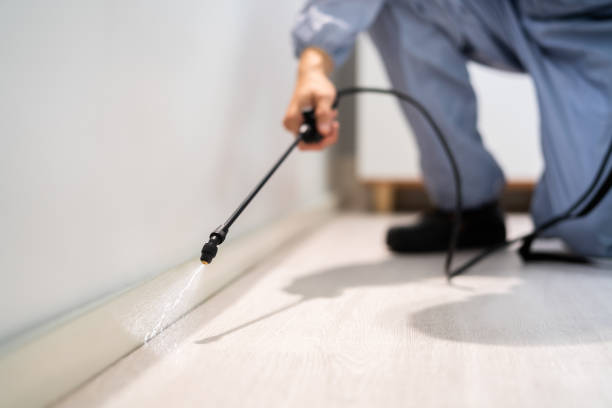
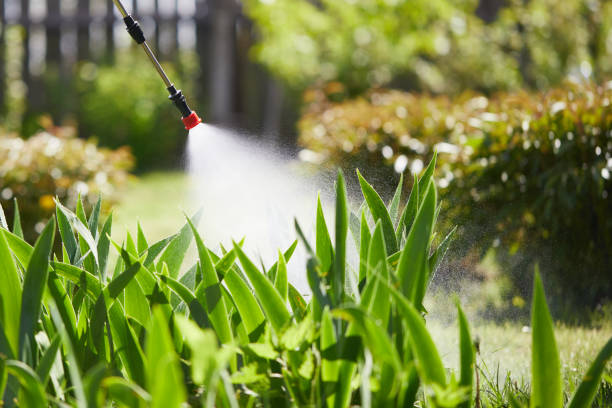
After nest elimination, we apply a residual treatment at the nesting site -- eave boards, ground nest entrance, void entry point -- that prevents new queens from establishing a colony at the same location next season. Wasps show strong site fidelity and will return to previous nesting locations if no residual barrier is present.
Paper wasps in St. George, KS are the species most frequently called about but least likely to represent a genuine safety emergency. Their open-comb nests under eaves and window frames are easily visible and often alarming in appearance, but the colony is relatively small and the wasps do not attack unless directly provoked. The key distinction from yellow jackets is the open hexagonal comb -- paper wasps do not enclose the nest in a paper envelope. A paper wasp nest that is not near a high-traffic area can often be monitored rather than immediately treated, but one near a door, a play structure, or a walkway where physical contact is possible should be removed professionally. The colony dies naturally in fall, but the nesting location should be treated with residual product to prevent re-establishment next season by a new queen.
Yellow jackets are a fundamentally different threat category than paper wasps. They are highly social, produce large colonies -- 3,000 to 5,000 workers or more by late summer -- and become extremely defensive within 20 feet of the nest entrance. Yellow jackets do not give a visual warning before stinging, do not sting once and release like bees, and can sting repeatedly. A disturbed yellow jacket ground nest produces a mass defensive response that can overwhelm a person retreating from the nest site, particularly if the person does not know the nest entrance location in advance. Ground nests are particularly dangerous because the entrance is frequently not visible until approached -- it may be a small hole at the base of a landscape feature, in a lawn edge, or between pavement slabs. Yellow jackets in St. George, KS do not reliably die off in mild winters -- colonies that experience only moderate cold may survive into the following season with a surviving queen and many workers, allowing the colony to reach much larger populations than typical first-year colonies.
Bald-faced hornets are a yellow jacket relative -- technically a wasp -- that builds the large, gray, papery football-shaped or teardrop-shaped nests visible in trees, attached to structures, and sometimes on utility poles or equipment. Despite their distinctive appearance, many people do not recognize bald-faced hornet nests and attempt to knock them down with a spray can from a short distance. This is consistently dangerous. Bald-faced hornets are highly aggressive within several feet of the nest and will pursue a perceived threat away from the nest site -- they do not limit their defensive response to the immediate nest perimeter the way paper wasps do. A large bald-faced hornet nest can contain 400 to 700 workers by late summer. Treatment requires approaching from a downwind angle at maximum application distance with appropriate protective equipment -- it is not a situation where proximity with a standard spray can is safe for an unprotected person.
Wasp nest near a doorway, play area, or pet area in St. George? Call +1-866-315-0243. We prioritize active stinging insect calls in St. George for same-day response.
The most problematic wasp situation from a DIY treatment standpoint is the void nest -- a yellow jacket colony established inside a wall void, soffit cavity, or attic space. Void nests are identified by a consistent entry point through a gap, crack, or opening in the exterior of the structure -- typically a wood joint, a gap in vinyl siding, or an opening around a pipe or conduit penetration. The number of workers entering and exiting the entry point is a reliable indicator of colony size and maturity. A large void nest may have a substantial buzzing sound audible from inside the adjacent room. Spraying the exterior entry point with consumer knockdown spray addresses only the guards at the entrance -- it does not reach the nest chamber inside the void, and it agitates the colony while leaving the population intact. The workers inside increase their defense activity, and the colony may begin exiting through secondary entry points deeper in the structure. The correct approach is void injection -- applying insecticide directly into the nest chamber through a small access point -- followed by sealing the primary entry after the colony is eliminated.
Fall is the appropriate window for preventive treatment at high-risk nesting sites -- eave boards where repeated nesting has occurred, attic gable vents with a history of yellow jacket activity, and ground nest entrance areas from the current season. Queens that mated in late summer overwinter in sheltered sites and re-establish nests in spring, showing strong fidelity to previous nesting locations. A residual product applied to former nesting sites in late fall -- after the colony has died or been eliminated -- deters new queen establishment in spring when queens begin scouting for nesting locations. This preventive application is especially effective for properties that deal with recurring annual nest establishment at the same location, which is a consistent pattern when the post-season residual is not applied. The cost of preventive fall treatment is a fraction of the cost of reactive season treatment.
We prioritize active stinging insect calls. Same-day service available in St. George and surrounding St. George, KS areas.
Call +1-866-315-0243Same-day dispatch for active nests. Scheduled visits for preventive treatment.

Full property sweep is the first step. Treatment sequence follows from the complete nest map.
Open-comb paper wasp nest removal from eaves, window frames, door frames, porch ceilings, and fence structures. Residual applied to the nesting site after removal to prevent next season's queen from re-establishing.
Ground nest treatment with full protective gear, correct product application to the nest interior, and entrance sealing to prevent reuse.
Hornet nests in trees and on structures treated from a safe distance with professional equipment. Do not attempt DIY treatment on enclosed hornet nests.
The entry-point spray fails for void nests. We access the nest chamber directly, treat at the source, and seal the entry.
Preventive fall treatment is the most cost-effective protection against recurring annual nesting at known sites.
The four steps that produce complete elimination -- not partial knockdown.
Phone assessment establishes the nest type and urgency. We confirm dispatch before you hang up.
Every technician arrives equipped for all nest types. The equipment appropriate to the specific situation is already on the vehicle.
We find all of them. The nest you called about and the ones you did not know about are both on the treatment list.
All nests treated, all sites residual-treated. Documentation left on-site. Follow-up timing confirmed.
Three different nest types, three different protocols, three problems solved.
I found the ground nest when I was nearly on top of it. Called Show Me Pest Control immediately. Same-day service on a Sunday. Technician found two additional nests during the sweep. Every nest treated. No stings at pickup the next day.
Attempted to spray what I thought was a wasp nest. Got stung 11 times before I got back inside. Show Me Pest Control identified it as bald-faced hornets -- a completely different threat level than I understood. Treated correctly. Inactive within 15 minutes. I had no idea there was such a difference between nest types until this happened.
The soffit spray was not working and the contractor could not explain why. Show Me Pest Control confirmed a void nest the moment they looked in the attic. Treated directly, sealed the entry. First season without stings at the entrance in two years.
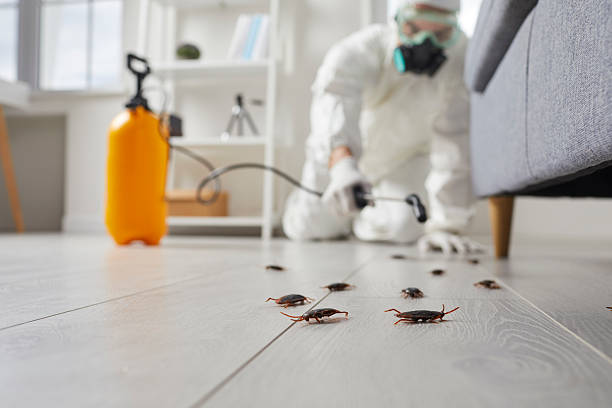
Same-day wasp removal in St. George. Call and we confirm arrival before you hang up. Full property nest sweep included on every visit.
Call +1-866-315-0243 -- Same Day